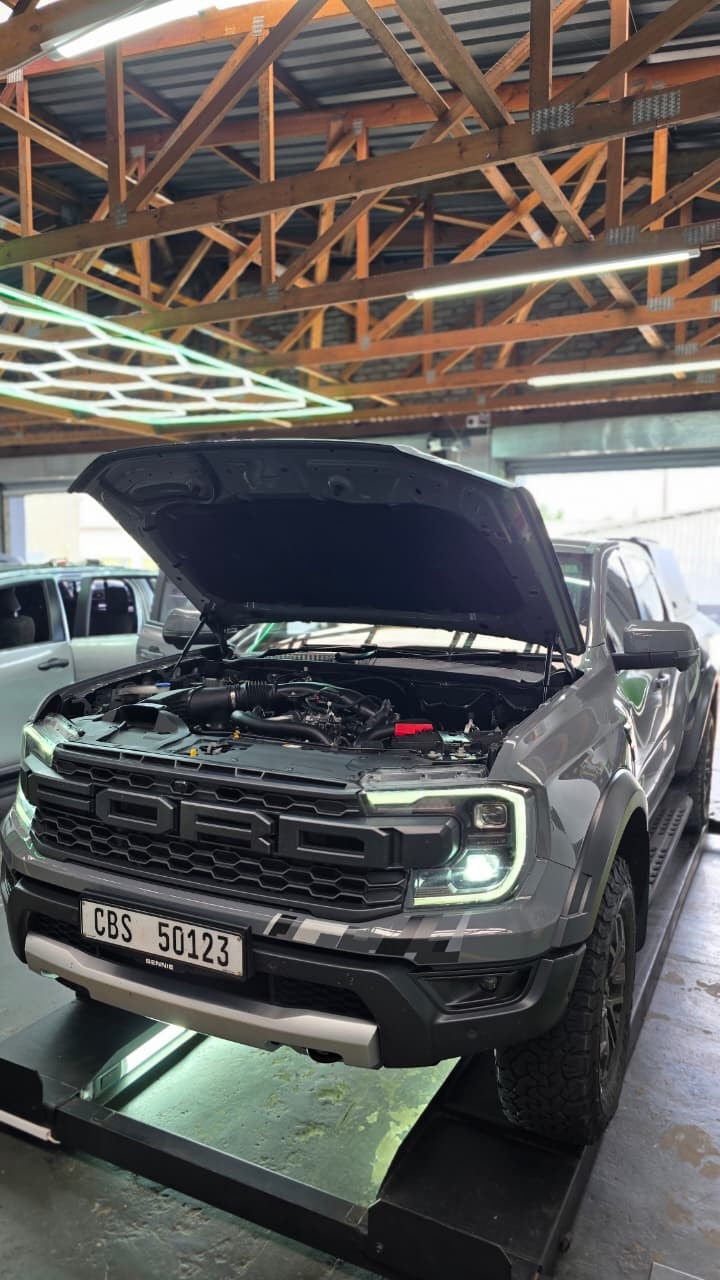
What Is an ECU Remap and How Does It Work?
Your bakkie might be leaving power and torque on the table — but what actually happens when you remap the ECU? And can more power really be gained without sacrificing reliability?
You've probably heard the words "ECU remap," "Stage 1," or "software tune" thrown around — but what actually happens when a vehicle is remapped? Is it just a way of making more power, or is there more to it? The answer is a little more interesting than you might think.
What Is an ECU? ECU stands for Engine Control Unit. Think of it as the computer that manages many of the important functions of your engine. Depending on the vehicle, the ECU controls and adjusts parameters such as fuel injection, boost pressure, ignition timing, throttle response, torque limits, air-fuel ratios, engine protection strategies and turbocharger control. Modern engines constantly use information from sensors around the vehicle to determine how the engine should operate. The ECU takes this information and uses its programmed maps and parameters to make decisions in real time.
So, What Is an ECU Remap? An ECU remap involves modifying specific parameters within the engine's software calibration. Manufacturers have to develop vehicles to operate reliably across a wide range of conditions, temperatures, altitudes, fuel qualities and driving styles. They also have to consider emissions regulations, noise requirements, component protection and the way the vehicle will be used across different markets. Because of this, there can sometimes be room to optimise the calibration for a particular vehicle and its intended use.
A professional remap changes selected parameters within the ECU calibration to alter how the engine responds. The goal isn't simply to make everything "higher." A good calibration is about finding the right balance between performance, drivability, reliability and the limits of the vehicle's components.
What Changes During a Remap? The exact changes depend on the vehicle, engine, ECU and the type of calibration being performed. On a turbocharged diesel engine, a tune may adjust boost pressure — more controlled boost can allow the engine to produce more torque and power. Fuel delivery timing can be adjusted to work with the revised airflow. Electronic torque limits programmed into different operating conditions can sometimes be adjusted. Throttle response can be altered to make the vehicle feel more responsive. A proper calibration should still respect the operating limits and protection strategies of the engine.
What Is a Stage 1 Remap? You'll often hear tuners talk about Stage 1, Stage 2 and Stage 3. These terms aren't universal industry standards, so what one company calls Stage 1 may not be identical to another company's Stage 1. Generally, a Stage 1 tune is designed around a standard, mechanically unmodified vehicle. The calibration is adjusted to improve the vehicle's performance without requiring major hardware changes. Depending on the vehicle, customers may notice increased torque, increased power, better throttle response, stronger acceleration and improved drivability. The actual results vary considerably between engines and vehicles.
What About Stage 2? Stage 2 usually refers to a calibration designed around additional hardware modifications — things like performance exhaust systems, improved intake systems, intercooler upgrades and other supporting modifications. The important question isn't what number is written on the package — it's what has actually been changed on the vehicle and what the calibration was designed around.
Does a Remap Make Your Vehicle Faster? It can. The biggest difference many drivers notice isn't necessarily the peak horsepower figure — it's the increase in torque and the way the vehicle responds under acceleration. This can make a bakkie feel considerably stronger when overtaking, climbing hills, carrying a load, towing, accelerating onto a highway or driving off-road. For a heavy 4x4 or bakkie, additional low- and mid-range torque can make a particularly noticeable difference.
What About Fuel Consumption? A remap doesn't automatically mean better fuel consumption. A well-calibrated vehicle can sometimes become more efficient under certain driving conditions because the engine may produce the required performance more easily. However, if you use the additional power and torque every time you drive, your fuel consumption can increase. In other words: the tune doesn't control your right foot. Driving style, vehicle weight, tyres, terrain, load and modifications can all have a significant impact on fuel consumption.
Can an ECU Remap Damage Your Engine? This is one of the most important questions to ask before getting a vehicle tuned. Poorly developed or overly aggressive software can place unnecessary stress on components. A responsible tune should take into consideration engine limitations, turbocharger limitations, fuel system capacity, cooling system, gearbox and clutch limitations, exhaust temperatures and existing vehicle condition. A remap also can't fix a mechanical problem. If an engine already has a failing turbocharger, injector, clutch, gearbox or cooling system, increasing its performance isn't going to make the underlying problem disappear. That's why the condition of the vehicle matters before tuning.
What About Automatic Gearboxes? Your engine isn't the only computer-controlled system in a modern vehicle. Many automatic transmissions also have their own control unit and programmed torque limits. Depending on the vehicle, gearbox software can potentially be adjusted to change shift points, shift timing, torque management, shift pressure and throttle response during shifts. This can complement an engine remap and help the transmission work appropriately with the additional engine torque. Just like engine tuning, the calibration needs to be developed around the specific gearbox and its limitations.
Is Every Remap the Same? Definitely not. Two vehicles with the same engine can produce different results depending on ECU version, vehicle specification, model year, hardware, fuel quality, existing modifications, vehicle condition and calibration strategy. That's why simply comparing two advertised "Stage 1" power figures doesn't necessarily tell you which tune is appropriate for your vehicle.
What Should You Ask Before Getting Your Vehicle Remapped? Before handing over your keys, ask the tuner: What exactly are you changing? Is the vehicle mechanically healthy? What supporting modifications are required? What happens if I have a problem afterwards? Is the calibration specific to my vehicle? A reputable tuner should be able to explain their process and support their work.
ECU Remapping at Rhino Customs. At Rhino Customs, we approach performance tuning as more than simply chasing the biggest number possible. Our goal is to improve the vehicle's power, torque and drivability while taking the vehicle's hardware and intended use into consideration. Whether you're looking for improved everyday performance, more torque for towing, or a stronger 4x4 setup, the right calibration depends on the specific vehicle. We also offer performance upgrades that can complement tuning, including exhaust systems and other supporting modifications. If you're considering an ECU remap, get in touch with us and let us discuss what makes sense for your vehicle. Visit us at Unit 2, 12 Brick Road, George Industria or call 076 068 7668.